Case Studies/Global Tech Start-Up [1998 - 2003]
Photonics Consulting - VPIphotonics
A global tech start-up in the telecommunications & photonics industries.
Taking research capability from Australian photonics CRC and partner universities and scale it as part of a global tech SaaS company.
Founder / group leader / numerical programmer; later Munich relocation to establish EMEA operations.
Global SaaS / follow-the-sun global footprint, €75m total funding, 220 staff, operations in Melbourne, Singapore, Minsk Belarus, Munich and Berlin Germany, Paris, London, Holmdel New Jersey, Texas Richardson and San Francisco USA.
Australia’s small domestic market means deep-tech companies must think globally from the outset — embedding themselves in leading international innovation ecosystems where customers, capital, capability and partners already exist.
End-to-end experience of taking academic PhD research to a successful global start-up.
Founder of and a numerical research programmer at Photonics Consulting Group Pty Ltd that was established at the Optical Sciences Centre at the ANU. This was as part of the Australian Photonics CRC in the mid nineties. This company merged with a Melbourne-based company called Virtual Photonics Pty Ltd. that eventually merged with BNED GmbH a spin-out company from the Fraunhofer Heinrich Herz Institute in Berlin. The resultant entity was called VPI photonics.
In 1998 28 million Euro VC was secured in the first round of funding. Three rounds of funding secured 75 million euro in total. From an Australian perspective, the company grew from 3 people to 220 within 3 years as the organisation went pre-IPO on the Nasdaq. Offices & Sales and Service operations were established in Melbourne, Singapore, Minsk Belarus, Munich, Berlin, Paris, London, Holmdel, NJ, and San Francisco.
After acquiring a division of Siemens Munich, Peter was required to relocate to Munich, Germany, to assist in establishing operations. Extensive experience was gained in establishing a global SaaS company with design, development, sales and service offices to provide a “follow-the-sun” solution.
“ A global technology start-up is never just about the company you build; it is about the capability, relationships and confidence you create to ensure the next venture is even more successful.”
Peter Moar, 2010
AUSBIRD
A tech start-up in the global space industry [2006-2009]
Secure venture funding, develop business case and secure commitment from end users to support the establishment of an Australian-German space startup company to design, build, launch and operate a constellation of LEO satellites primarily for global fire detection and monitoring.
Founder/CTO/commercialisation lead across Australia and Germany.
$4m AUD secured; DLR and German partners engaged; concept later connected to DESIS capability.
I learned that deep-tech ventures involving government customers require long horizons, rigorous risk reduction and extraordinary persistence. Although AUSBIRD did not achieve its original commercial ambition, the relationships it created became a platform for two decades of successful Australia–Germany collaboration — proving that trust and capability can outlive the venture itself.
AUSBIRD International (AUSBIRD) was a venture established by Australian and German commercialisation partners. The partnership was established in 2005 when Peter secured commitment from relevant German and Australian organisations whilst working and living in Munich Germany. State and Federal Australian Governments were lobbied to support the establishment of AUSBIRD. Eventually, the South Australian Government presented the most attractive package with the Minister for Industry traveling to Cologne Germany to sign an MOU with the head of the DLR committing both Government organisation to the success of AUSBIRD.
AUSBIRD International Pty Ltd was incorporated in Australia to operate worldwide. Shareholders were Euro Pacific Aerospace Pty Ltd, Kayser-Threde GmbH (now OHB GmbH) and the German Aerospace Center (DLR).
The aim was to establish an Australian company/start-up, and sovereign industrial supply chain, to design and manufacture micro-satellites to provide a constellation of at least five and up to twelve for global fire detection and environmental monitoring. The DLR and German Industry Partners would manufacture 80% of the first constellation of satellites with eventual manufacturing of subsequent constellations to be transferred to Australia.
$4m AUD was secured from Australian investment partners. Due to the Global Financial Crisis in 2008, the investors at the time decided to wind down commercial operations.
Although the venture was wound down viable ongoing collaborations with the DLR have resulted is significant successes of designing and deploying instrumentation into space such as the DLR Earth Sensing Imaging Spectrometer (DESIS).
German Aerospace Center (DLR) and State of Victoria Space Instrumentation Mission Success
Publications & Media
-
![]()
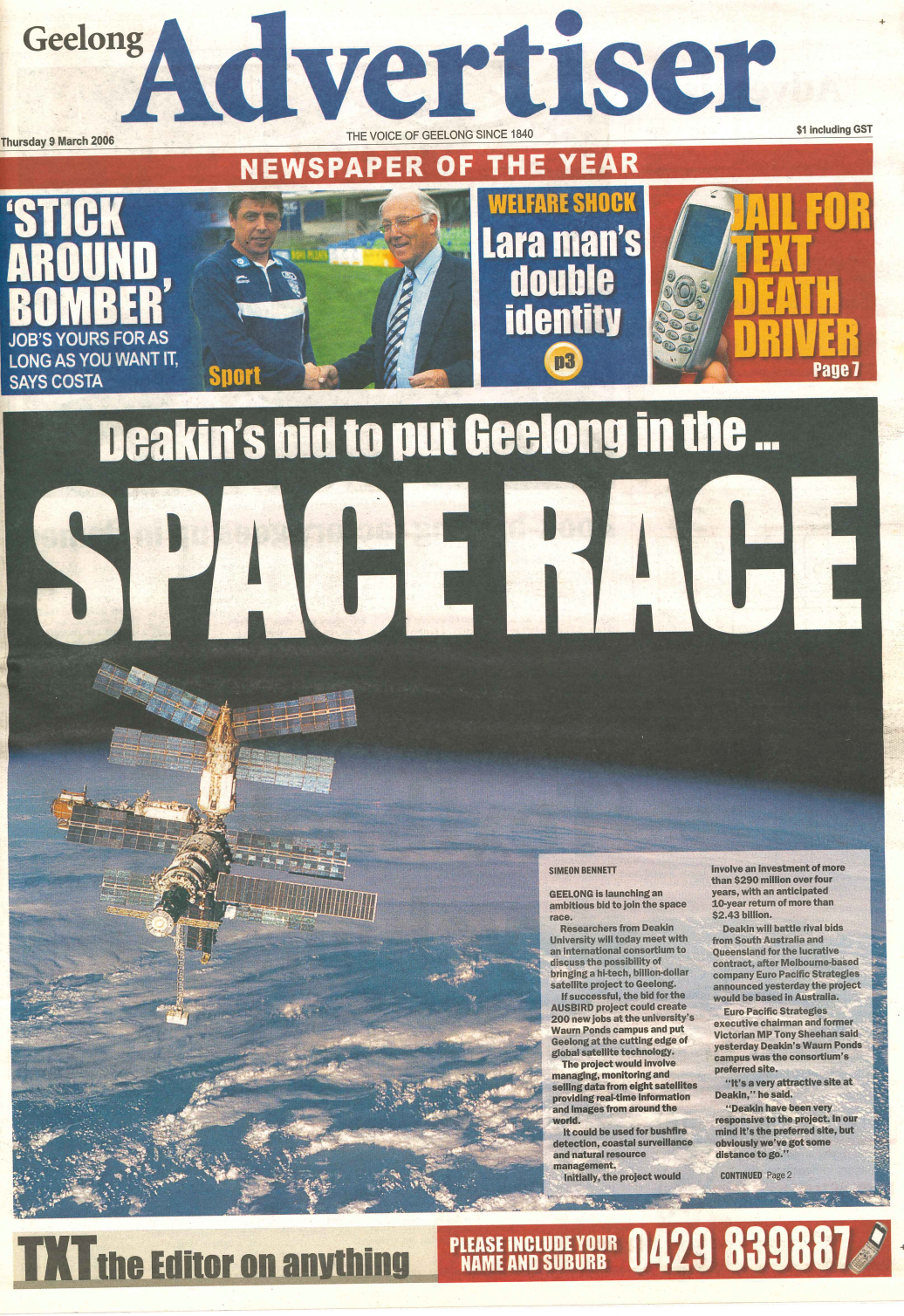
Geelong Advertiser Article
“Deakin’s bid to put Geelong in the Space Race”
-
![]()
The Australian Article
“Blazing new trails”
-
![]()
The Australian Article
“Mini-satellites on bushfire patrol”
-
![]()
Adelaide Now Article
“Push for satellite deal”
-
![]()
The Australian Article
“Eyes in the sky to fight bushfires”
-
![]()
The Age Article
“New bushfire detection system praised”