Case Study · Regional Industrial Transformation
Bendigo Fraunhofer Initiative
Adapting a proven German regional transformation model for Australian conditions.
I initiated the Bendigo Fraunhofer journey while at La Trobe University, asking whether the place-based applied-research model I had seen in Germany could help regional Australian industry navigate digital transformation. The work developed from an idea in 2015 into a multi-year industry-government-academia initiative involving the Fraunhofer Institute for Experimental Software Engineering (IESE), regional industry through the Bendigo Manufacturing Group (BMG), local and state government through the City of Greater Bendigo, universities through La Trobe University and innovation specialists.

The Challenge
How could regional Australia translate capability into new industrial growth?
La Trobe University's regional footprint created an opportunity to differentiate engineering and applied research through direct engagement with regional industry.
Bendigo had a strong manufacturing base, a major La Trobe campus and a community confronting the long-term pressures facing traditional industry. My starting question was simple: had another region already faced a comparable challenge, and could its lessons be adapted rather than copied?
That question led me to Fraunhofer IESE in Kaiserslautern and to a regional transformation story that would become the reference point for Bendigo.
Why Kaiserslautern
A working model for indsutrial AI ecosystem place-based transformation
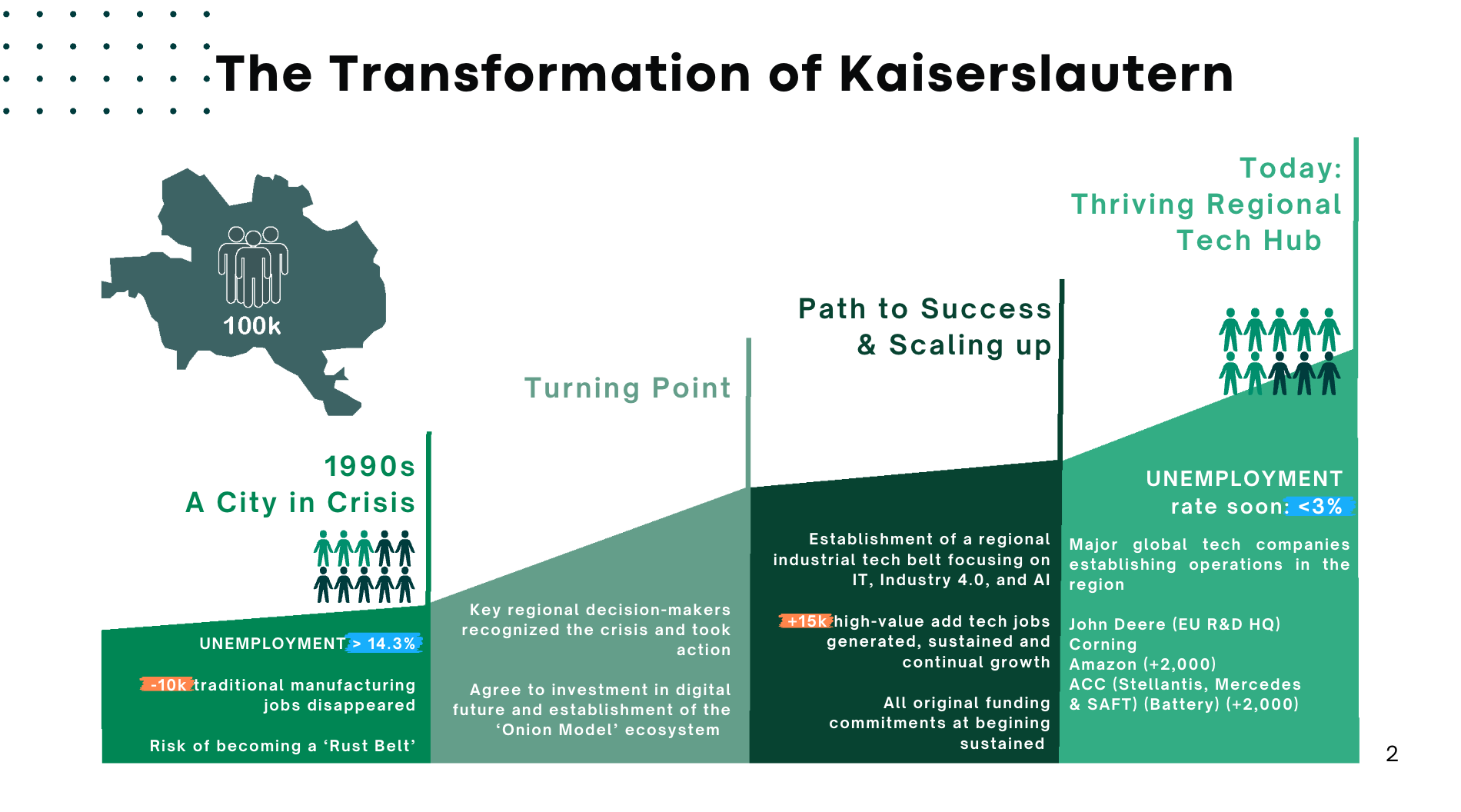
Kaiserslautern demonstrated that regional industrial decline could be confronted by deliberately building a new ecosystem around applied research, universities, industry, government and future technology.
Traditional industry declines
Major manufacturing disruption creates an urgent need for a different regional economic future.
Future industries become the focus
The region accepts and understands it is a crisis and commits to a digital manufacturing future through industrial AI/Industrie 4.0 capability, software engineering, advanced technology and new forms of industrial value in 1995.
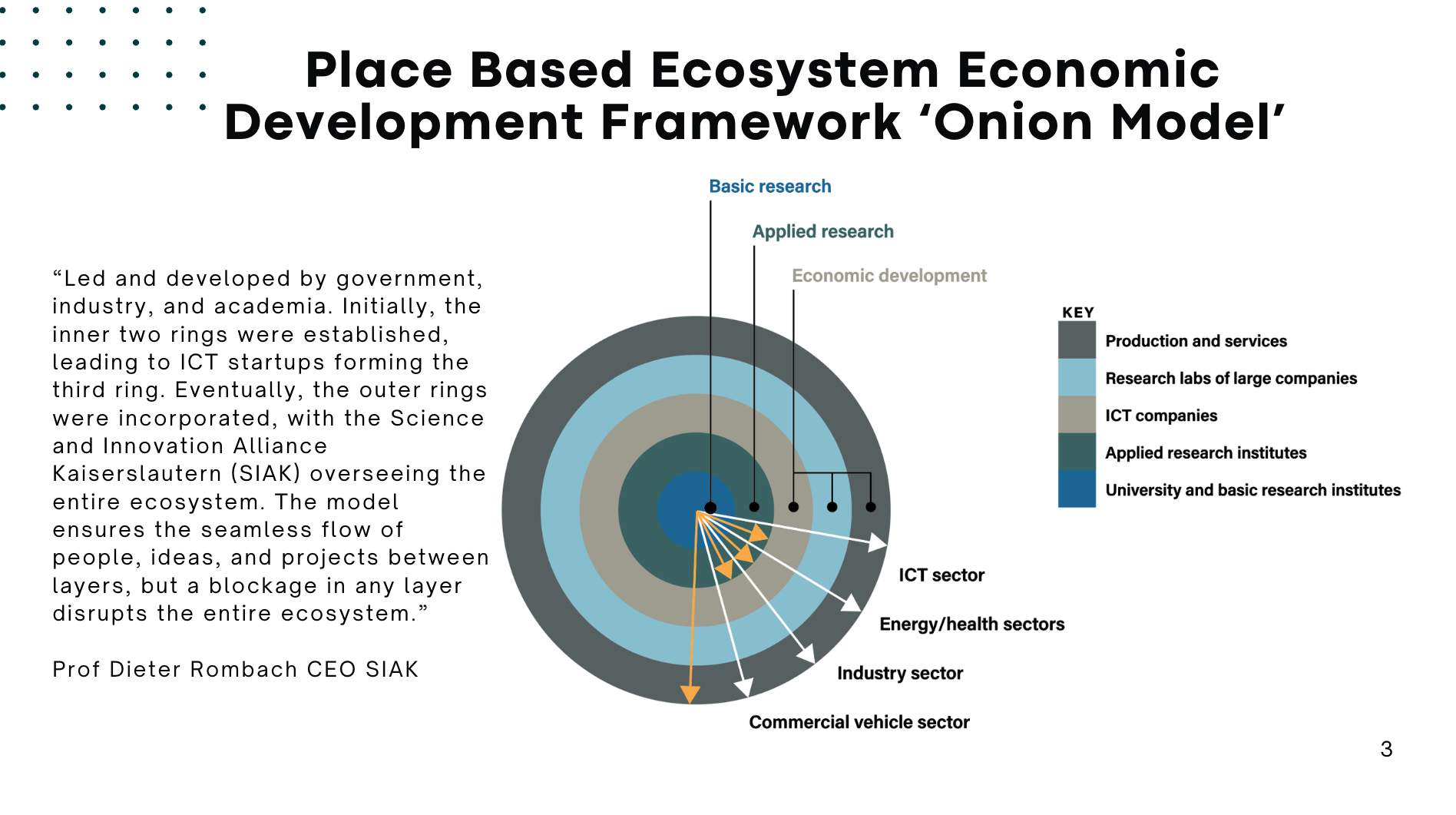
Applied research translation connects the system
Fraunhofer, universities, companies and government build a coordinated place-based innovation ecosystem.
High-value technology employment grows
The contemporary project video describes the creation of more than 10,000 high-value technology jobs over roughly 15 years.
The Insight
Adapt the principles, not the institution.
The lesson was not that Australia should mechanically copy a German institute. The deeper insight was that successful regional transformation depends on a connected ecosystem, trusted local leadership, applied research capability and a mechanism for moving ideas into industry.
Assembling the Right Capability
Three complementary perspectives
The Bendigo initiative brought together complementary German and Australian expertise rather than relying on a single imported model.
Prof. Dieter Rombach
Founding director of Fraunhofer IESE and an international applied-research institution builder. He helped establish Fraunhofer centres and project-centre activity in Germany, North America and South America, bringing practical global experience in adapting the Fraunhofer model to different national and regional contexts.
A/Prof. Anton Kriz
Australian regional innovation-management expertise, focused on how regions, firms and institutions build practical innovation capability.
Dr Peter Moar
Engineering, international commercialisation and Australia-Germany partnership experience, connecting the opportunity, institutions and implementation pathway.
The Bendigo Coalition
Industry, government, academia and applied research at the same table
The initiative was built through a coalition of regional and international organisations. The logo strip below uses current organisation marks as a visual record of the organisations involved in the initiative.


For the final production page, upload approved logo files into Squarespace and replace these external asset links with Squarespace-hosted copies.
23–27 April 2018
The Bendigo Fraunhofer Workshop Week
The workshop week converted the concept into a regional design exercise. Rather than arriving with a predetermined answer, the partners worked through the needs of government, industry and the region, then translated those findings into the first framework for a Centre for Digital Transformation.
Monday: government and regional transformation context.
Tuesday: industry and regional company workshops.
Thursday: presentation and engagement with Victorian Government stakeholders.
Friday: consolidated findings, governance concept, structure and funding requirements.
From Workshop to Operating Concept
A regional capability, not a one-off project
The 2018 week produced an initial framework for a Bendigo Centre for Digital Transformation, including structure, personnel, operating principles and funding requirements. The intended logic was long-term: connect academic research with industrial practice, embed capability locally, attract talent and give companies an applied pathway from ideas to implementation.
The exact centre model originally envisaged was not ultimately implemented. The subsequent funded program used a different operating model, while retaining core elements of the innovation and technology-translation approach.
From Commitment to Funding
The initiative moved through successive stages of proof
Regional concept agreed
The workshop week produced the first framework for the regional digital-transformation capability.
Pilot commitment
Stakeholders committed to continuing the initiative and regional companies backed technology pilot projects.
Practical collaboration
Fraunhofer IESE continued applied innovation activity with La Trobe and Australian industry.
A$3 million secured
A$2 million in federal funding and a further A$1 million Victorian contribution supported the next implementation phase.
Optimised model implemented
The pilot implemented an adapted German Fraunhofer methodology together with Australian Regional Innovation Management change management through the TILT program.
Funding converted the regional concept into an implementation program.
The funds supported technology projects with companies in the Bendigo region and the implementation of an adapted innovation-management approach combining German and Australian practices.
How the Model Worked
TILT · Next Level Growth
The funded work combined technology translation with the organisational capability needed for companies to absorb and act on new R&D.
The Triggering Innovation Leadership Transformation (TILT) program brought company leaders through a staged process from readiness and strategic alignment to project framing, implementation, reflection and stronger innovation capability.
Next level growth process
Business, process and product innovation
Aligning purpose, strategy and objectives
Project framing and initiation
Action and champion the project
Implement and reflect on the project
Improve ordinary and dynamic capabilities
Next level leader and enterprise
Implementation & Outcomes
The pilot moved beyond workshops into embedded capability and company projects
Fraunhofer IESE expertise was embedded in Bendigo during the funded implementation period, including a full-time staff member and additional visiting specialists. Regional companies participated in technology projects while TILT supported the organisational and leadership changes required to make R&D adoption practical.
A$3m implementation base
Government funding provided the resources to move from concept and business planning into practical regional technology projects.
Fraunhofer capability embedded locally
Fraunhofer IESE personnel worked in Bendigo rather than delivering the methodology only from Germany.
Industry projects in the region
Regional companies participated in technology-specific projects supported by the funded program.
Hybrid Australian-German methodology
Fraunhofer Rapid Innovation Labs were combined with Australian Regional Innovation Management through the TILT program.
Triple Helix capability
Industry, university and government stakeholders gained practical experience in regional technology translation and transformation.
A platform for national thinking
The Bendigo experience became an important practical input into the later national technology-translation proposition now evolving as Tech Translate Australia.
Bendigo demonstrated that German applied-research practice could be combined with Australian regional innovation capability. It also showed the limitation of short funding cycles: sustained industrial transformation requires permanent local capability, trusted relationships and a long-term institutional platform.
What This Journey Demonstrates
Turning an international insight into an Australian regional platform
The Bendigo Fraunhofer Initiative captures how I approach complex opportunities: understand the system, identify relevant international experience, assemble complementary capability, align institutions with different priorities, secure commitment and resources, stay with implementation, and convert the learning into something that can scale.
Legacy
From Bendigo to a wider Australian technology-translation proposition
The Bendigo experience became a practical reference point for a broader question: how could Australia build enduring technology-translation capability for its "missing middle" companies and regions?
The relationships, methodology and lessons developed through Bendigo subsequently informed wider stakeholder engagement across universities, industry groups and regional innovation networks. That work has continued to evolve into the national proposition now called Tech Translate Australia.
The Next Chapter
Tech Translate Australia
Bendigo was the regional test. Tech Translate Australia asks how the lessons can be applied at national scale through connected place-based ecosystems linking Australian industry with applied research, universities, government and international capability.