National Industrial R&D Translation Initiative
Tech Translate Australia
Re-industrialising Australia through applied research, engineering and technology translation.
Tech Translate Australia is a proposed national network of place-based technology-translation ecosystems designed to strengthen Australia's missing-middle SMEs, build sovereign industrial capability and create globally competitive technologies, companies and high-value jobs.
The initiative is informed by nearly three decades of Australia-Germany deep-tech experience and by an Australian pilot that tested how international applied-research methods could be adapted to local industry and regional conditions.

Why
Australia's missing middle is an industrial system gap
Australia produces world-class research, technologies and ideas. Too much promising capability, however, struggles to cross the distance between invention and sustained industrial scale.
Tech Translate Australia is designed to fill a missing piece in the national industrial R&D ecosystem: the applied-research, engineering and translation capability required by SMEs to develop, validate, industrialise and commercialise complex technologies.
Research & invention
- Universities and public research
- Deep-tech founders and start-ups
- Scientific and engineering capability
- New-to-world technologies and ideas
Technology translation & industrialisation
- Applied engineering and prototyping
- Industrial validation and demonstration
- Production capability and systems integration
- Commercial pathways, skills and market access
Industrial scale & global markets
- Globally competitive products and services
- Stronger Australian SMEs
- Sovereign industrial capability
- High-value jobs and export industries
Why now
The competitive window is narrowing
Industrial complexity
Australia's industrial complexity and productivity are under pressure. Business as usual has not produced technology translation at the scale required.
AI and global competition
Artificial intelligence and accelerating technological change are compressing innovation cycles and intensifying competition between nations, firms and regions.
A proven Australian pilot
The Bendigo Fraunhofer Initiative provided a practical Australian test bed for adapting applied-research and regional-transformation methods to local conditions.
The policy case
Why the Australian Innovation System Needs Fraunhofer Institutes
Co-authored with Dr John H. Howard and published by the Acton Institute for Policy Research and Innovation, this opinion piece examines Australia's persistent research-to-industry translation gap and the need for applied-research institutions capable of connecting universities, industry and government.
The policy argument provides the national rationale; Tech Translate Australia develops that rationale into a scalable Australian operating model.
What
A national technology-translation network
Tech Translate Australia proposes a nationally connected network of applied-research and technology-translation institutes operating through metropolitan hubs and regional spokes.
The network would connect industry and SMEs with applied engineering, research infrastructure, specialist talent, government programs, capital and international markets. It would adapt leading international models to Australian needs rather than copy a foreign institution unchanged.
The objective is enduring Australian capability: stronger firms, more complex products and services, deeper industrial supply chains and nationally significant sovereign capability.
National network
Metropolitan hubs connected to regional industrial ecosystems
Metro hubs would provide critical mass in research, engineering, specialist infrastructure and international connectivity. Regional spokes would anchor the network in existing industrial clusters and place-based economic ecosystems.
Illustrative network architecture. Final locations, sequencing and institutional form would be determined through the business-plan and governance phase.
One connected Australian system — metro hubs, regional spokes
Illustrative national hub-and-spoke animation from the Industrial Transformation of Australia proposal. Locations and sequencing remain subject to the business-plan and governance phase.
Initial national capability themes
Focused where industrial capability and global opportunity intersect
The network would be organised around nationally important technology domains, selected for industrial relevance, sovereign need and the potential to build globally competitive Australian capability.
Industrial AI
The evolution of Industry 4.0: using AI, data, automation and digital engineering to improve design, production, maintenance and industrial decision-making.
Cybersecurity
Protecting industrial systems, supply chains, critical infrastructure, embedded technologies and connected production environments.
Health Technologies
Translating medical, digital-health, biomanufacturing and assistive technologies into validated products and scalable industrial capability.
Quantum & Photonics
Building pathways from advanced scientific capability into sensing, communications, computing and high-value manufacturing applications.
Energy Transition
Supporting industrial decarbonisation, energy technologies, green manufacturing, critical minerals and resilient regional supply chains.
How it works
Adapting Kaiserslautern's place-based ecosystem model for Australia
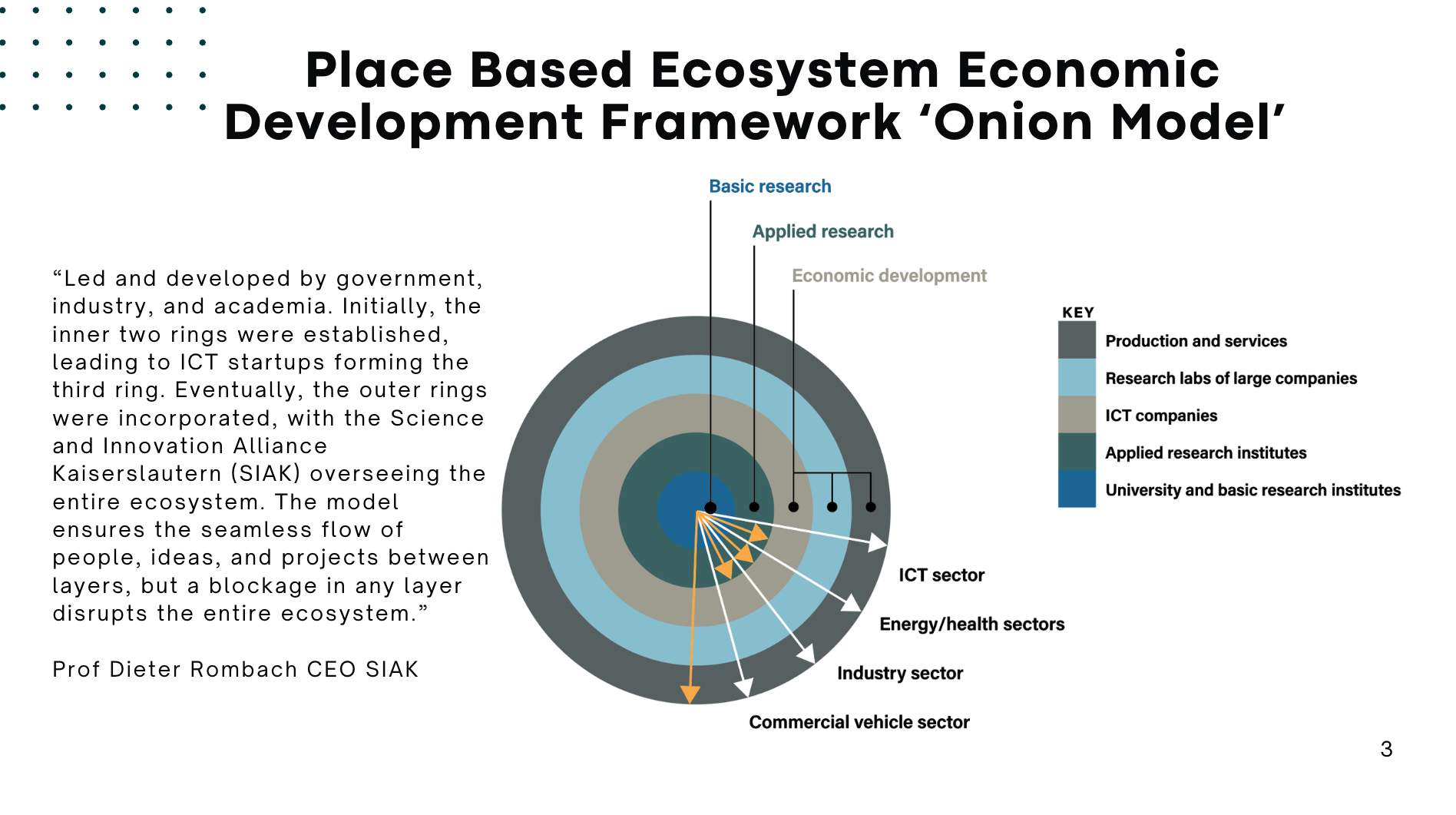
The Kaiserslautern Onion Model connects university and basic research, applied-research institutes, technology companies, corporate research and established industry as mutually reinforcing layers of one regional ecosystem.
Tech Translate Australia proposes adapting this proven architecture to Australian regions and priority industries. Its central principle is that people, knowledge, projects and capability must move continuously between the layers rather than remain isolated within individual institutions.
Evidence base
Nearly three decades of learning, testing and refinement
Australia-Germany experience
Deep-tech ventures, advanced manufacturing, applied research and international collaboration across both innovation systems.
Learn from proven models
Kaiserslautern demonstrated how place-based applied research, industry, universities and government can support regional transformation.
Adapt and pilot in Bendigo
The Bendigo initiative tested an Australian-German technology-translation approach with regional industry and government.
Build national infrastructure
Tech Translate Australia converts the learning into a national proposition focused on SMEs, regions and sovereign industrial capability.
Australian proof point
From concept to an implemented regional pilot
The Bendigo Fraunhofer Initiative demonstrated that elements of an international applied-research and regional-transformation model could be adapted to Australian conditions rather than copied unchanged.
The initiative brought industry, government, academia and Fraunhofer expertise together, secured A$3 million and implemented an adapted Australian-German methodology through the TILT program.
Implementation
A business-plan phase followed by a ten-year national rollout
The proposal separates early design and mobilisation from long-term implementation, allowing governance, investment, capability themes and anchor partnerships to be established before national deployment.
Business plan and mobilisation
- Develop the detailed national business case
- Establish governance and institutional architecture
- Confirm priority capability themes and initial locations
- Identify foundation institutes, hubs and regional spokes
- Secure anchor industry, government and university partners
- Complete detailed economic, legal and implementation planning
National rollout and capability building
- Establish and progressively expand the national network
- Launch industry-led applied-research and translation programs
- Connect metropolitan hubs with regional industrial ecosystems
- Integrate international best practice and global partnerships
- Build specialist workforce and leadership capability
- Implement annual monitoring and five-year reviews
Expected outcomes
What national success would look like
More engineering, technical, scientific and industrial careers generated and sustained in Australia.
Greater ability to design, manufacture, maintain and control strategically important technologies.
More research and technology translated into products, companies, supply chains and market outcomes.
Place-based industrial ecosystems that retain value, strengthen SMEs and diversify regional economies.
Indicative investment and economic case
National-scale capability requires national-scale commitment
Proposal modelling aligned with potential national reconstruction and Future Made in Australia funding pathways.
Indicative economic modelling from the current proposal, subject to validation during the business-plan phase.
A sustained program of works rather than a short-term project or isolated funding round.
Call to participate
Building Australia's next generation of industrial capability will require a national coalition
We are engaging with industry, government, universities, regional organisations and international applied-research partners interested in shaping the next stage of Tech Translate Australia.